Showing posts with label Antonia. Show all posts
Monday, 1 April 2013
Friday, 1 February 2013
Wednesday, 28 November 2012
Staff Picks - Best Books of 2012: Antonia
Swimming Home by Deborah Levy
I'd loved Alison's Moore's The Lighthouse - which was also shortlisted for The Booker this year - and Swimming Home is similarly a short, tight and powerful novel. But while The Lighthouse has a meandering ambiguous quality to its story, Swimming Home is considerably more resonant and dramatic. There are so many phrases, sentences and paragraphs in the book that sing. The novel explores the devastating effect that depression
can have on apparently stable, well-turned-out people. Set in a summer
villa, the story is tautly structured, taking place over a single week
in which a group of beautiful, flawed tourists in the French Riviera
come loose at the seams.
May We Be Forgiven by AM Homes
I'd not read any of AM Homes's novels until this one, and I enjoyed May We Be Forgiven so much that I'll definitely be looking at her backlist. Critically acclaimed as belonging to the tradition of Jonathan Franzen and Suri Hustvedt (The Guardian said it had ‘the narrative intensity of
Franzen’s
The Corrections and the emotional punch of Hustvedt’s
What I Loved’), this is an exploration of family life beginning at a Thanksgiving celebration, a novel about connections, broken, made and remade, existing physically, emotionally and, increasingly, electronically. One of the strongest openings in fiction that I've read for ages - just start reading and you won't be able to stop. The sort of book that makes you excited about books all over again.
The Hanging Garden by Patrick White
2012 was all about Patrick White: May marked the centenary of his birth, Happy Valley was finally republished as a Text Classic after being out of print for decades, the excellent Patrick White exhibition visited the State Library, and we were treated to publication of his previously unpublished novel The Hanging Garden. Whether you've long been a fan of Patrick White or haven't read him yet, I do urge you to read The Hanging Garden. Two children are brought to a wild garden on the shores of Sydney
Harbour to shelter from the Second World War. The boy's mother has died
in the Blitz. The girl is the daughter of a Sydney woman and a Communist
executed in a Greek prison. In wartime Australia, these two children
form an extraordinary bond as they negotiate the dangers of life as
strangers abandoned on the far side of the world.
Tuesday, 6 November 2012
Interview: Robin Sloan
Robin Sloan grew up near Detroit and has worked at Poynter, Current TV
and Twitter in jobs that have generally had ‘something to do with
figuring out the future of media’. We asked him some questions about his new book Mr Penumbra's 24 Hour Book Store - a charming and hilarious adventure that has it all: secret societies,
unbreakable codes, underground lairs, cutting-edge technology, the
googleplex…and lots of books!
One of the best things about the novel is the collision of old and new
technologies. What's important to you about embracing both the old and
the new?
The thing I've
realised is that you don't have to choose. New technologies and new
formats rarely erase the old ones. Sure, there are exceptions—nobody
needs a buggy whip, and increasingly, nobody needs a CD either—but in
general, the history of media is the history of things piling up and
combining in interesting ways. It's a collision, sure, but not the kind
where one side gets obliterated; instead, it's the kind where things
merge, combine, and you can never really pick them apart again.
You've worked for Twitter and call yourself a media inventor - what does a media inventor do?
It's
pretty simple: a media inventor is someone who is primarily concerned
with content—words, pictures, ideas—but also interested in designing new
ways for that content to be presented. For example: this year I've been
experimenting with iPhone apps.
The content is still just text, but it's presented in a very different
way, using a format that doesn't quite have a name yet. I've been
calling it a "tap essay"... and the fact that I struggled to come up
with that name is, to me, a sign that I'm going in the right direction.
Actually,
maybe that's a sharper, simpler definition: a media inventor is someone
who works with formats that don't have names yet.
What's the best thing about writing a Twitter update, a short story, and a novel?
Twitter
is great because it forces you to really think about sentences. I've
spent more time crafting words -- figuring out new ways to say
something, new ways to compose a thought -- in that little Twitter text
field than anywhere else.
Short stories are
great -- at least in my view -- because they can function like
prototypes. They represent a way to get a fairly complete idea out into
the world and see how people respond. MR. PENUMBRA'S 24-HOUR BOOKSTORE
started as a short story, and it was only after it got such a warm
reception that I contemplated expanding it into a novel.
And
novels are great for a simple but powerful reason: they receive
readers' undivided attention for hours, sometimes days.The only other
formats with that distinction are probably video games and serial TV
dramas. Both of those cost millions of dollars to make. Novels still
just take imagination and time.
What about the hardest things about writing Twitter updates, short stories, and novels?
Twitter updates: the knowledge that they have a half-life of approximately three minutes.
Short
stories: the knowledge that even today, on the internet, without any of
the constraints of print, short stories don't have a huge readership.
It's a funny format that too often slips between the cracks.
Novels: the knowledge that I'm going to be sitting here for a long, long time. (But really, that's not so bad.)
What's your favourite thing about bookstores?
No
question: bookstores are still the best machines
for serendipitous media discovery we've yet invented. Are they
efficient? Not really. Do they always work? No. But when they do work,
it's magic. You'll stumble across something that no algorithm would ever
have chosen for you. You'll pick it up, turn it over in your hands.
Flip to a random page. Read one paragraph, then another. Gauge the
voice. All of this in a matter of seconds -- faster than you could ever
go click-click-click on a website. That's a kind of user interface -- a
kind of technology. And it's a really good one.
Thursday, 1 November 2012
Wednesday, 31 October 2012
Event: Ramona Koval
When Ramona Koval began to speak, the entire bookshop seemed suddenly
at ease. Hers is a voice that we instantly recognise, as familiar as listening to an old friend, someone who we've been tuning into for years on ABC's Radio National. On Monday we had a chance to listen to her much-loved voice once again, when she came to Shearer's to talk about her new book By the
Book.
Ramona spoke of her love of bookstores, and that being around books was where the idea for By the Book started. She told us about her childhood of reading, and the books her mother bought her as a child - and had a great anecdote about her mother purchasing a copy of the karma sutra! Certain books shaped her childhood, and there were books that defined her mother and family and what life was like for them. Ramona remembered a book in her house called Home Management Volume One. Published in the 1950s, it told you how to be a perfect family. She read it looking for instruction about how families and love worked, finding she often turned to books to find out about how the world worked, and especially to learn about love.
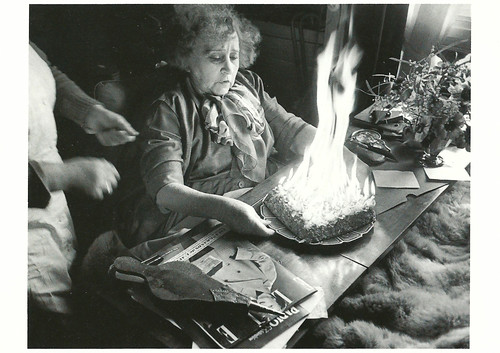
An important book for Ramona was Colette's My Mother's House and Sido, where Colette plays fictional variations on the themes of childhood, family, and, above all, her mother. She delighted in Colette's stories, and encouraged us to read Colette if we hadn't yet - plus look for a photo of Colette on her 80th birthday taken by Walter Carone of her burning birthday cake (here it is!).
While Ramona loved Colette, nothing surprised her more than The Man Who Loved Children by Christina Stead. It mirrored the fault lines of her family, and the lack of affection between her parents. Her French teacher set Madame Bovary at school, and Ramona wrote an essay - calling EmmaBovary a woman ahead of her time. She was the only student in her class who didn't think that Emma Bovary was a bad wife and bad mother, just that she was an unhappy and bored woman. Because Ramona felt as though Emma was describing her own adolescent life: her mother restricted her social life, and chose her clothes. But she was grateful that her mother never restricted her reading life.
Ramona also told us a lovely story about how her granddaughter is learning to read, and read the first paragraph of her book. Her relationship to the books that have been written into her life was beautiful to hear, and By the Book is a wonderful memoir. It was also interesting to hear about how she treats her books! She said: "My books were my workplace, my office. I wrote in pencil all over them."
After signing some books for us, Ramona had to dash off to an interview with Phillip Adams on Late Night Live on the ABC. You can her the interview with Phillip here: http://www.abc.net.au/radionational/programs/latenightlive/ramona-koval-on-reading/4337932
- Antonia
Ramona spoke of her love of bookstores, and that being around books was where the idea for By the Book started. She told us about her childhood of reading, and the books her mother bought her as a child - and had a great anecdote about her mother purchasing a copy of the karma sutra! Certain books shaped her childhood, and there were books that defined her mother and family and what life was like for them. Ramona remembered a book in her house called Home Management Volume One. Published in the 1950s, it told you how to be a perfect family. She read it looking for instruction about how families and love worked, finding she often turned to books to find out about how the world worked, and especially to learn about love.
An important book for Ramona was Colette's My Mother's House and Sido, where Colette plays fictional variations on the themes of childhood, family, and, above all, her mother. She delighted in Colette's stories, and encouraged us to read Colette if we hadn't yet - plus look for a photo of Colette on her 80th birthday taken by Walter Carone of her burning birthday cake (here it is!).
While Ramona loved Colette, nothing surprised her more than The Man Who Loved Children by Christina Stead. It mirrored the fault lines of her family, and the lack of affection between her parents. Her French teacher set Madame Bovary at school, and Ramona wrote an essay - calling EmmaBovary a woman ahead of her time. She was the only student in her class who didn't think that Emma Bovary was a bad wife and bad mother, just that she was an unhappy and bored woman. Because Ramona felt as though Emma was describing her own adolescent life: her mother restricted her social life, and chose her clothes. But she was grateful that her mother never restricted her reading life.
Ramona also told us a lovely story about how her granddaughter is learning to read, and read the first paragraph of her book. Her relationship to the books that have been written into her life was beautiful to hear, and By the Book is a wonderful memoir. It was also interesting to hear about how she treats her books! She said: "My books were my workplace, my office. I wrote in pencil all over them."
After signing some books for us, Ramona had to dash off to an interview with Phillip Adams on Late Night Live on the ABC. You can her the interview with Phillip here: http://www.abc.net.au/radionational/programs/latenightlive/ramona-koval-on-reading/4337932
- Antonia
Monday, 1 October 2012
Saturday, 1 September 2012
Friday, 20 July 2012
Video Interview: Richard Ford
We were thrilled to have Pulitzer Prize winning author Richard Ford take some time out from his busy Australian tour and come into Shearer's last week to sign some books and have a coffee (black) with us. He spoke to Antonia about his new book Canada, keeping the first draft of the novel in the freezer, his preoccupation with consequences and his writing routine.
In Canada, Richard Ford has created a masterpiece. A visionary novel of vast landscapes, complex identities and fragile humanity. It questions the fine line between the normal and the extraordinary, and the moments that haunt our settled view of the world.
Friday, 29 June 2012
Subscribe to:
Posts (Atom)